
 English
 中文简体
中文简体
Search By Posts
Product Category
Industry News
 By Admin
What Is 2-Hydroxyethylhydrazine and Why Is It Important in Modern Chemical Industry?
2-Hydroxyethylhydrazine (CAS: 109-84-2) is an important organic intermediate widely used in pharmaceuticals, agrochemicals, polymer materials, and specialty chemical manufacturing. With increasing demand for high-performance chemical intermediates, this compound has gained attention for its multifunctional chemical properties and its role in synthesizing various industrial products.
As industries continue to expand into advanced materials and specialty chemicals, understanding the value and applications of 2-Hydroxyethylhydrazine becomes increasingly important for manufacturers and researchers.
Content
Overview of 2-Hydroxyethylhydrazine
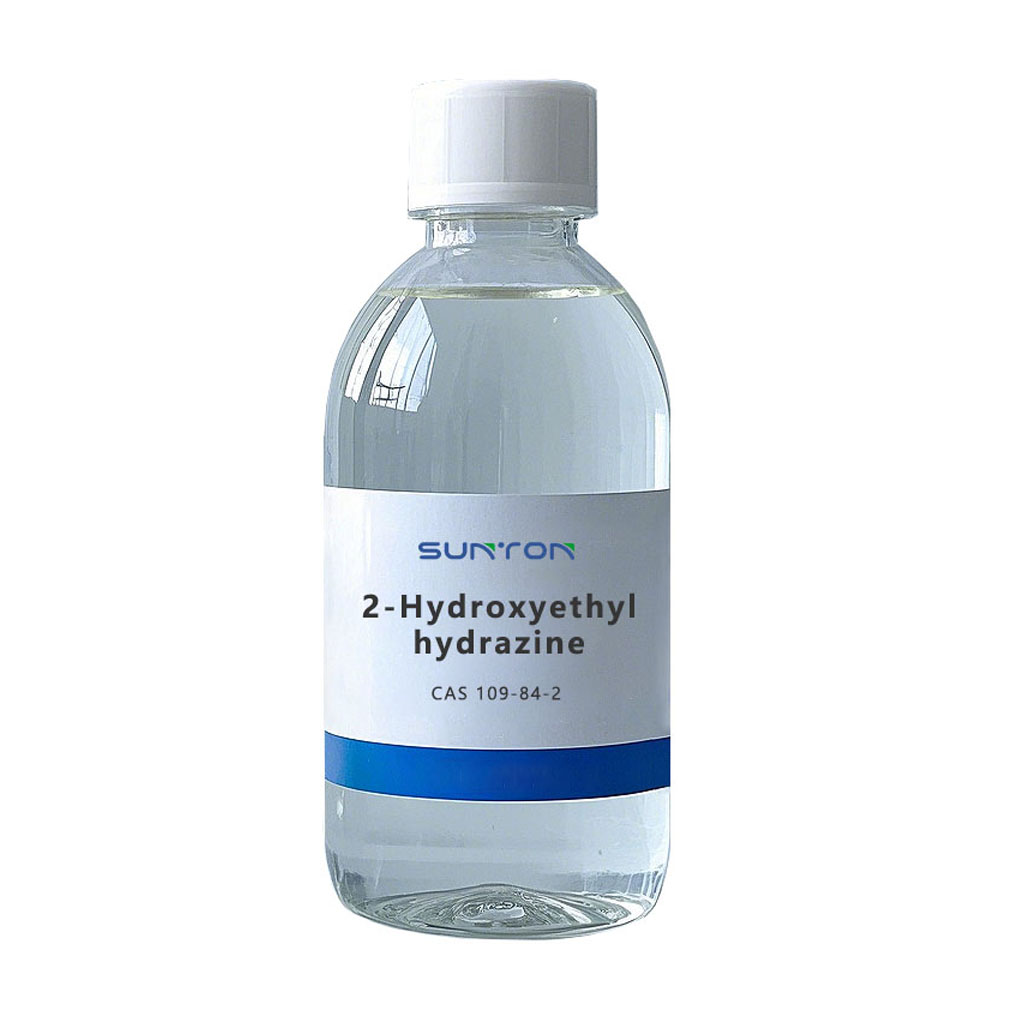
2-Hydroxyethylhydrazine, also known as 2-hydrazinoethanol, is a hydrazine derivative containing both hydroxyl and hydrazine functional groups. It appears as a colorless or light-yellow viscous liquid and acts as a strong reducing agent in many chemical reactions.
Basic Chemical Information
| Property | Value |
|---|---|
| Chemical Name | 2-Hydroxyethylhydrazine |
| CAS Number | 109-84-2 |
| Molecular Formula | C₂H₈N₂O |
| Molecular Weight | 76.1 g/mol |
| Appearance | Colorless or light yellow viscous liquid |
| Melting Point | −70 °C |
| Density | About 1.12 g/mL (25 °C) |
| pH Value | 9-11 |
Because it contains amine and hydroxyl groups, the compound shows strong reactivity, making it suitable for organic synthesis and polymer modification.
Key Industrial Applications
2-Hydroxyethylhydrazine has a wide range of industrial applications thanks to its unique chemical structure. It serves as both a chemical intermediate and a functional additive across several industries.
Major Applications of 2-Hydroxyethylhydrazine
| Pharmaceutical Industry | Intermediate for antibacterial drugs such as Furazolidone |
| Agriculture | Plant growth regulator and crop development enhancer |
| Polymer Industry | Stabilizer for polyurethane and polyacrylonitrile |
| Energy & Oil Industry | Corrosion inhibitor in oil wells |
| Chemical Manufacturing | Intermediate for heterocyclic compounds and specialty chemicals |
For example, one of its most important uses is as a key intermediate in the synthesis of furazolidone, a broad-spectrum antibacterial compound widely used in veterinary medicine.
In addition, its effectiveness as a plant growth regulator allows it to support agricultural productivity by promoting flowering and crop development.
Role in Polymer and Materials Industry
The polymer industry increasingly relies on functional intermediates to enhance material stability and performance. 2-Hydroxyethylhydrazine contributes in several ways:
-
Acts as a polymer stabilizer in polyurethane and polyacrylonitrile materials
-
Functions as a chain extender in urethane formulations
-
Improves durability and resistance in synthetic materials
These properties make it particularly valuable in applications such as:
-
Coatings and paints
-
Textile fibers
-
Electronic materials
-
Industrial plastics
In advanced material research, scientists have also explored its potential in electronic materials and flexible circuit substrates, highlighting its versatility beyond traditional chemical synthesis.
Production and Synthesis Process
Industrial production of 2-Hydroxyethylhydrazine generally involves the reaction between hydrazine hydrate and ethylene oxide under controlled temperature conditions.
Typical Synthesis Process
| Raw Material Preparation | Hydrazine hydrate dissolved in water |
| Reaction Stage | Ethylene oxide slowly added at 30-70 °C |
| Reaction Control | Temperature maintained in closed system |
| Purification | Separation and refinement of product |
This process enables large-scale production with controlled purity levels such as 95%, 98%, and 99%, depending on industrial requirements.
Storage and Safety Considerations
Due to its reactive chemical nature, proper storage and handling are essential.
Storage Guidelines
| Storage Environment | Dark and sealed containers |
|---|---|
| Temperature | Cool conditions |
| Packaging | Chemical drums or IBC containers |
| Compatibility | Avoid oxidizing agents |
The compound is also corrosive to certain materials such as rubber and glass and must be handled with appropriate protective equipment.
Future Market Prospects
The global demand for chemical intermediates continues to grow with the development of pharmaceuticals, advanced materials, and specialty chemicals.
Several trends are expected to drive future demand for 2-Hydroxyethylhydrazine:
-
Expansion of pharmaceutical intermediates production
-
Increased use in agrochemical formulations
-
Development of high-performance polymers
-
Emerging research in energy and electronic materials
As industries continue to pursue higher-efficiency materials and chemical processes, compounds like 2-Hydroxyethylhydrazine will remain essential building blocks for innovation.
FAQ
1. What is 2-Hydroxyethylhydrazine mainly used for?
It is primarily used as an organic intermediate, especially in pharmaceutical synthesis, agrochemicals, polymer stabilizers, and corrosion inhibitors.
2. Is 2-Hydroxyethylhydrazine used in agriculture?
Yes. It can act as a plant growth regulator, promoting flowering and improving crop development.
3. What industries rely on this chemical?
Major industries include pharmaceuticals, agriculture, polymer materials, coatings, textiles, and specialty chemicals.
4. What are the storage requirements?
It should be stored in sealed containers, protected from light, and kept away from oxidizing substances.
5. Why is it important for chemical synthesis?
Its hydrazine and hydroxyl functional groups allow it to participate in a wide range of reactions, making it a versatile intermediate in organic chemistry.
NEXT:How Does Benzene, 1,4-bis(1-methylethyl)-, Homopolymer Improve the Crosslinking Density in High-Temperature Resin Formulations?
Recommended products
-
2,3-Dimethyl-2,3-Diphenylbutane (Dicumene)
-
Benzene,1,4-bis(1-methylethyI)-,Homopolymer
-
2-Hydroxyethylhydrazine
-
Acethydrazide
-
Tert-Butyl peroxybenzoate(TBPB)
-
Benzoyl Peroxide(BPO)
-
1,2-Hexanediol
-
Pentylene Glycol
-
Caprylohydroxamic Acid
-
Melamine Cyanurate
-
Di-Tert-Butyl Peroxide(DTBP)
-
XPS Special Masterbatch
COMPANY PROFILE
CONTACT INFO
- Phone: +86 18114870532
- Tel: +86 510-86686637
- Email: [email protected]
- Add: No.5 Shuangquan village, Diaoqi village., Xuxiake Town, Jiangyin, Jiangsu, China

Copyright © Jiangsu Suoteng New Material Technology Co., Ltd. All Rights Reserved.Custom Chemicals Organic Compounds Manufacturers
 Disclaimer
Privacy
苏ICP备2024090995号
Disclaimer
Privacy
苏ICP备2024090995号