
 English
 中文简体
中文简体
Search By Posts
Product Category
Industry News
 By Admin
TBPB (Tert-Butyl Peroxybenzoate): Properties, Uses & Safety
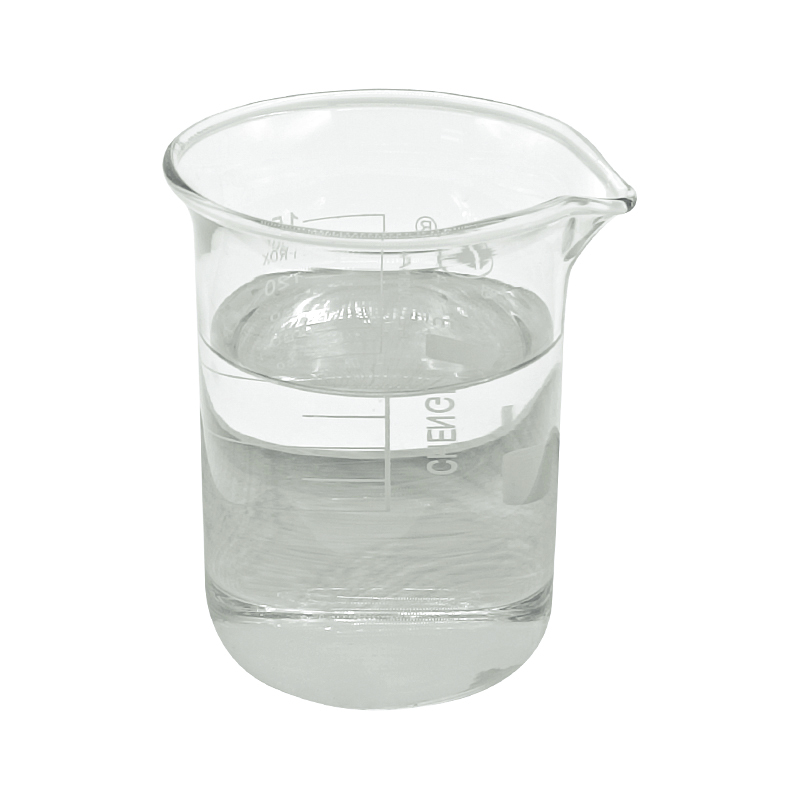
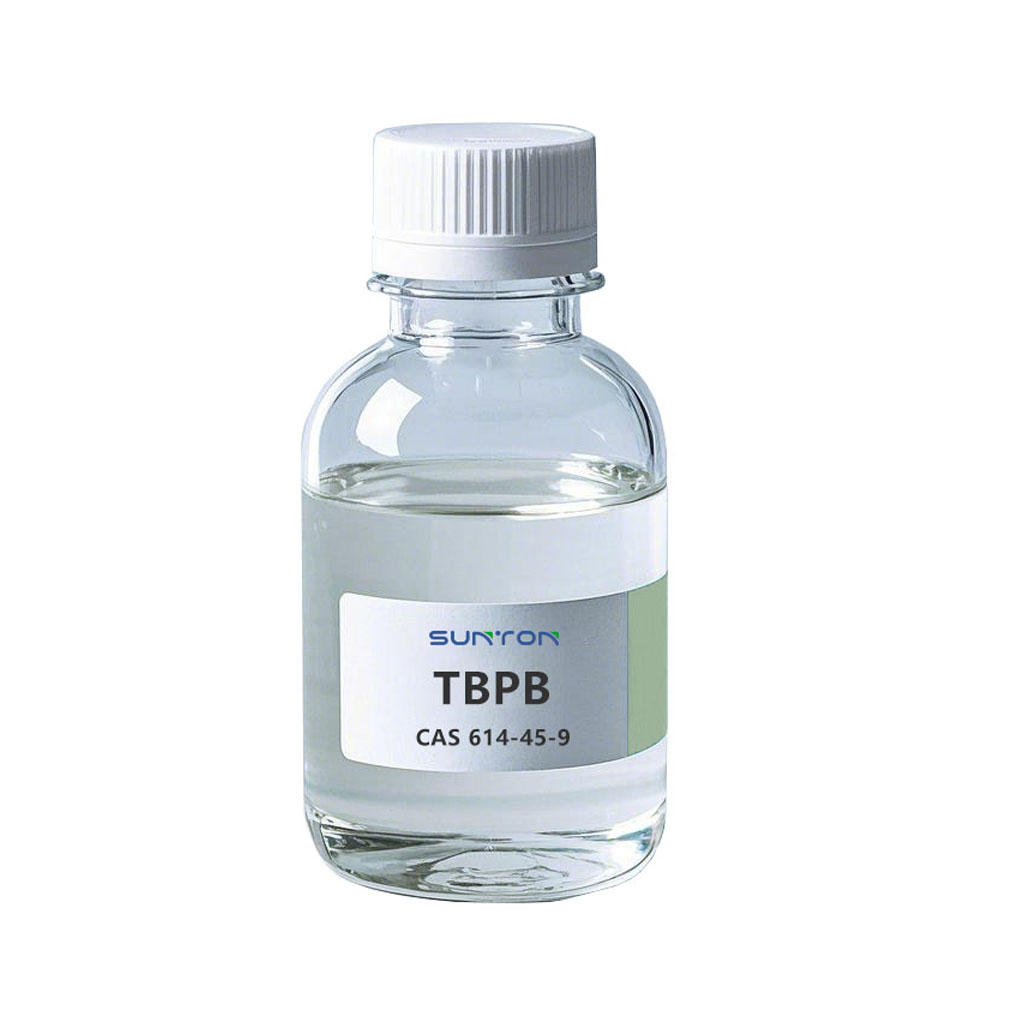
Content Tert-butyl peroxybenzoate, commonly abbreviated as TBPB, is an organic peroxide belonging to the peroxyester family. Its chemical formula is C11H14O3, with a molecular weight of 194.23 g/mol. Structurally, it consists of a benzoate group linked through a peroxide bond (–O–O–) to a tert-butyl group. This peroxide bond is the chemically active site: it is relatively weak (bond dissociation energy approximately 150 kJ/mol) and cleaves homolytically under thermal activation to generate two free radicals. At room temperature, TBPB is a clear to slightly yellow liquid with a faint, characteristic ester-like odor. Its key physical properties: TBPB occupies a mid-range position in the organic peroxide activity spectrum. Its decomposition temperature is higher than many dialkyl peroxides and diacyl peroxides, which makes it useful for processes requiring sustained radical generation at temperatures between 100°C and 140°C — a range that suits a broad category of polymer processing and curing applications. The primary industrial function of TBPB is as a free radical initiator in polymerization and crosslinking reactions. When heated to its effective decomposition range, the peroxide bond undergoes homolytic cleavage, producing a tert-butoxy radical and a benzoyloxy radical. The benzoyloxy radical may further decompose to yield a phenyl radical and carbon dioxide. These radicals are highly reactive species that initiate chain reactions in unsaturated monomers or abstract hydrogen atoms from polymer chains to generate macroradicals for crosslinking. The rate at which radicals are generated — and therefore the rate of initiation — is a function of temperature and follows first-order kinetics. Process engineers select TBPB when they need: In practical terms, TBPB is often used as a secondary or finishing initiator in multi-initiator polymerization systems. A faster-decomposing peroxide handles the bulk of the reaction at lower temperature; TBPB activates at higher temperature to convert residual monomer, driving conversion toward completion and reducing volatile monomer content in the final product. TBPB's temperature-activity profile makes it useful across several polymer and rubber processing industries. In the composites industry, TBPB is widely used to cure unsaturated polyester (UP) and vinyl ester resins, particularly in elevated-temperature processes such as pultrusion, resin transfer molding (RTM), and compression molding. It provides a controlled exotherm at temperatures above 120°C, which is appropriate for thick-section pultruded profiles where a premature or sharp exotherm would cause internal cracking. Typical loading levels range from 0.5 to 2.0 parts per hundred resin (phr) depending on the resin system, part geometry, and target cure cycle. TBPB serves as a peroxide vulcanizing agent for silicone rubber, EPDM, and other saturated or specialty elastomers that cannot be efficiently crosslinked with sulfur-based systems. Peroxide crosslinking with TBPB produces C–C crosslinks rather than sulfidic linkages, resulting in vulcanizates with superior heat resistance, lower compression set, and better performance in contact with oils and chemicals. It is particularly used in compression-molded and transfer-molded silicone parts processed at 150–180°C. In the manufacture of polystyrene, high-impact polystyrene (HIPS), and styrene-acrylonitrile (SAN) copolymers via continuous bulk or solution polymerization, TBPB functions as a high-temperature initiator in the later stages of the reactor train. Its activity at 120–140°C allows it to reduce residual styrene monomer levels at the tail end of the process, improving product quality and reducing the need for downstream devolatilization. TBPB is also used as an initiator in the production of acrylic polymers for coatings, adhesives, and sealants where solution or bulk polymerization is conducted at elevated temperatures. Its controlled decomposition rate helps maintain consistent molecular weight distribution in the final polymer. As with all organic peroxides, TBPB requires strict temperature-controlled storage and careful handling. Its hazard profile is governed by the instability of the peroxide bond and the potential for self-accelerating decomposition (SAD) if temperature control is lost. TBPB is classified under the UN transport system as UN 2096 (organic peroxide, type D, liquid) and is subject to the requirements of the GHS/CLP classification system as a flammable liquid (Category 3) and organic peroxide (Type D). Handlers should consult the current Safety Data Sheet (SDS) from their supplier for jurisdiction-specific classification, emergency response guidance, and PPE requirements, as formulation concentration and regional regulations affect the precise hazard category assigned.What Is Tert-Butyl Peroxybenzoate (TBPB)?
How TBPB Functions as a Radical Initiator
Industrial Applications
Unsaturated Polyester Resin Curing
Rubber Vulcanization
Styrenic Polymer Production
Acrylic Polymer and Coating Applications
Storage, Handling, and Safety
Storage Requirements
Handling Precautions
Regulatory Classification
NEXT:Benzoyl Peroxide: Structure, Formula, Molecular Weight & Properties
Recommended products
-
2,3-Dimethyl-2,3-Diphenylbutane (Dicumene)
-
Benzene,1,4-bis(1-methylethyI)-,Homopolymer
-
2-Hydroxyethylhydrazine
-
Acethydrazide
-
Tert-Butyl peroxybenzoate(TBPB)
-
Benzoyl Peroxide(BPO)
-
1,2-Hexanediol
-
Pentylene Glycol
-
Caprylohydroxamic Acid
-
Melamine Cyanurate
-
Di-Tert-Butyl Peroxide(DTBP)
-
XPS Special Masterbatch
COMPANY PROFILE
CONTACT INFO
- Phone: +86 18114870532
- Tel: +86 510-86686637
- Email: [email protected]
- Add: No.5 Shuangquan village, Diaoqi village., Xuxiake Town, Jiangyin, Jiangsu, China

Copyright © Jiangsu Suoteng New Material Technology Co., Ltd. All Rights Reserved.Custom Chemicals Organic Compounds Manufacturers
 Disclaimer
Privacy
苏ICP备2024090995号
Disclaimer
Privacy
苏ICP备2024090995号