
 English
 中文简体
中文简体
Search By Posts
Product Category
Industry News
 By Admin
DTBP Dosage Guide: Decomposition Kinetics & Peroxide Comparison
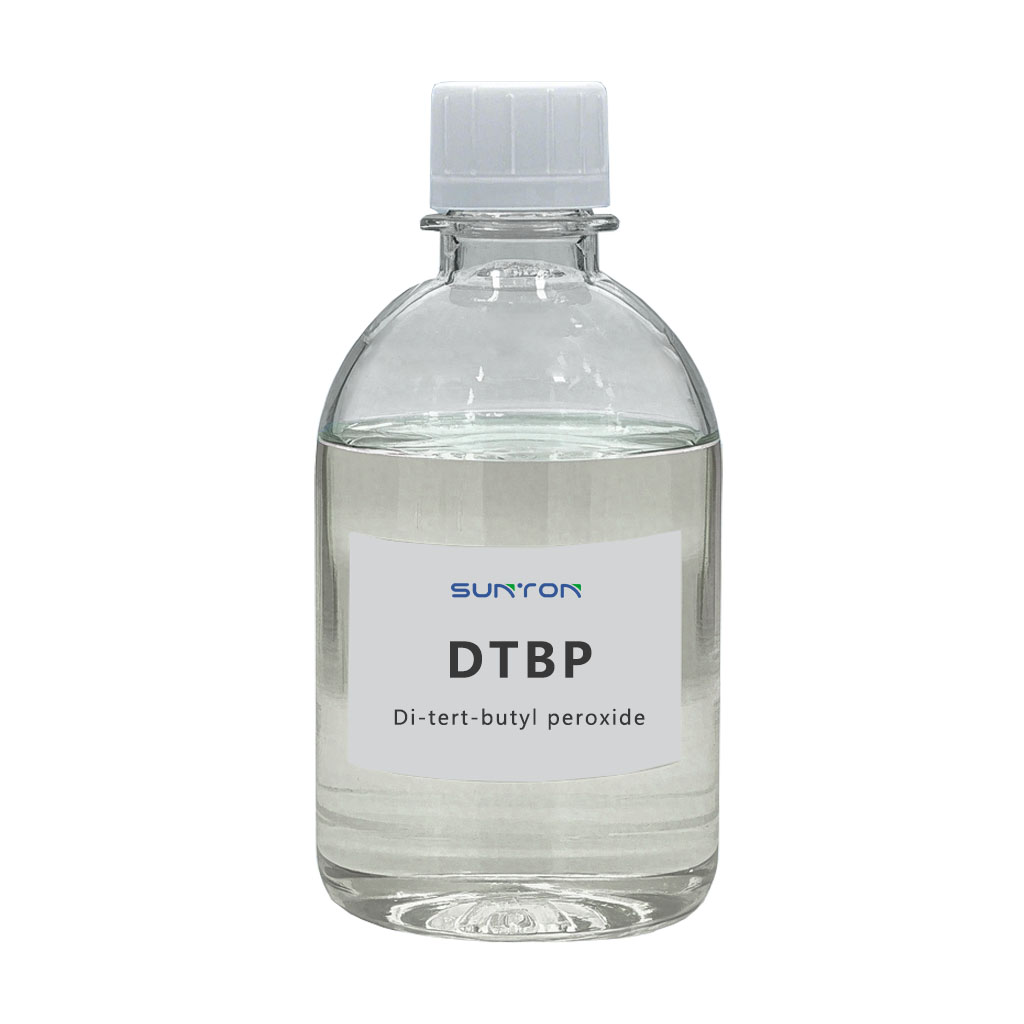
Choosing the right dosage of Di-Tert-Butyl Peroxide (DTBP) for a given polymer system comes down to balancing active oxygen content, processing temperature, and the desired crosslink density — get any one of these wrong and the result is either undercured material or a batch that gels too early in the extruder.
This article focuses on the practical side of working with DTBP: dosage logic, decomposition behavior, and how it stacks up against other peroxide options when formulating a process recipe.
Content
How Decomposition Kinetics Drive Dosage Decisions
DTBP decomposes through first-order kinetics, meaning the rate of radical generation depends only on temperature and time, not on concentration. This makes its behavior predictable across batch sizes, but it also means formulators need to plan around the half-life curve rather than guessing.
| Half-life duration | Approximate temperature |
|---|---|
| 1 minute | Approximately 193°C |
| 1 hour | Approximately 149°C |
| 10 hours | Approximately 126°C |
Typical Dosage Ranges by Application
Dosage is usually expressed as a percentage of the resin or monomer weight, and the right figure depends heavily on the target crosslink density or molecular weight.
- Polyethylene crosslinking for wire and cable: dosage commonly falls in the low single-digit percentage range, fine-tuned against line speed and target gel content.
- EPDM and silicone rubber curing: dosage is adjusted against co-agent ratios, since DTBP alone produces a different network structure than when paired with crosslinking co-agents.
- Bulk or solution polymerization of styrene-type monomers: dosage is kept low relative to monomer weight, since the goal is chain initiation rather than full network formation.
DTBP vs. Other Common Peroxide Initiators
Formulators rarely choose a peroxide in isolation — the decision is almost always a comparison against the alternatives available for a given temperature window.
DTBP vs. Dicumyl Peroxide (DCP)
DCP activates at a somewhat lower temperature and is widely used for general-purpose rubber curing, but it can leave an acetophenone odor in the finished part. DTBP's decomposition products are lighter and less persistent, which is why it's often favored in applications where odor matters, such as cable jacketing near enclosed spaces.
DTBP vs. Tert-Butyl Peroxybenzoate (TBPB)
TBPB sits at a lower half-life temperature than DTBP, making it more suitable for moderate-temperature curing, whereas DTBP is reserved for processes that genuinely need the extra thermal headroom, such as high-speed extrusion lines running above 200°C.
Common Formulation Mistakes to Avoid
- Underestimating residence time at temperature, which leads to incomplete decomposition and unreacted peroxide left in the finished product.
- Overdosing in an attempt to speed up curing, which can create localized scorch or uneven crosslink density rather than a faster, even cure.
- Ignoring antioxidant or stabilizer interactions, since some additives can scavenge radicals and effectively reduce the active dose of DTBP in the final compound.
- Storing premixed masterbatches too long before processing, since gradual peroxide decomposition during storage shifts the effective dosage at the point of use.
Frequently Asked Questions
Can DTBP be blended with other peroxides in one formulation?
Yes, dual-peroxide systems combining a lower-temperature and higher-temperature initiator are common, allowing curing to begin at a moderate temperature while DTBP completes the network at higher temperatures later in the process.
Does humidity affect DTBP dosage accuracy?
DTBP itself is not highly moisture-sensitive, but consistent metering equipment calibration matters more than ambient humidity for maintaining accurate dosage across production runs.
How is residual peroxide content typically measured after curing?
Residual active oxygen content is most commonly checked via iodometric titration or differential scanning calorimetry (DSC), both of which reveal whether the decomposition reaction reached completion during processing.
NEXT:XPS Special Masterbatch Guide: Types, Dosage & Compatibility
Recommended products
-
2,3-Dimethyl-2,3-Diphenylbutane (Dicumene)
-
Benzene,1,4-bis(1-methylethyI)-,Homopolymer
-
2-Hydroxyethylhydrazine
-
Acethydrazide
-
Tert-Butyl peroxybenzoate(TBPB)
-
Benzoyl Peroxide(BPO)
-
1,2-Hexanediol
-
Pentylene Glycol
-
Caprylohydroxamic Acid
-
Melamine Cyanurate
-
Di-Tert-Butyl Peroxide(DTBP)
-
XPS Special Masterbatch
COMPANY PROFILE
CONTACT INFO
- Phone: +86 18114870532
- Tel: +86 510-86686637
- Email: [email protected]
- Add: No.5 Shuangquan village, Diaoqi village., Xuxiake Town, Jiangyin, Jiangsu, China

Copyright © Jiangsu Suoteng New Material Technology Co., Ltd. All Rights Reserved.Custom Chemicals Organic Compounds Manufacturers
 Disclaimer
Privacy
苏ICP备2024090995号
Disclaimer
Privacy
苏ICP备2024090995号